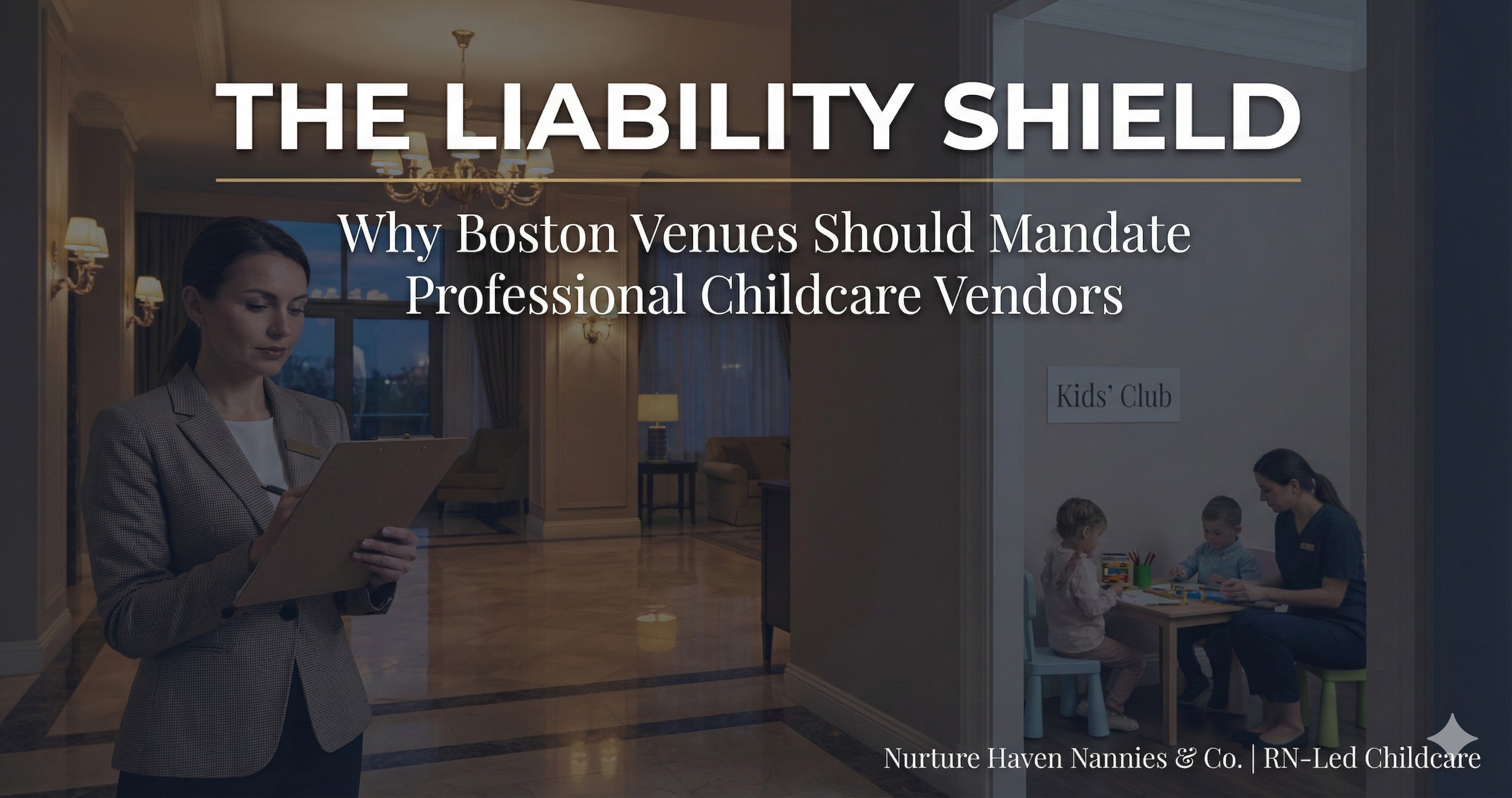
Across the Boston hospitality industry, a quiet shift is underway. High-end wedding venues—from the Langham Boston to historic estates in Concord and Lincoln—are adding a new line to their preferred vendor lists: professional, insured childcare providers.
The reason? A growing awareness of a liability gap that most venues didn't realize existed: the "cash sitter" problem.
When guests bring unvetted, uninsured caregivers onto hotel or venue property to supervise children during events, they're inadvertently creating legal exposure for the venue itself. And as family-inclusive weddings become the norm rather than the exception, this exposure is scaling rapidly.
Engagement season is in full swing, and as couples tour venues throughout Metrowest and Greater Boston, the question of "what to do with the kids" is inevitably arising. For many venues, children are often viewed as a logistical wildcard—a potential source of noise complaints, property damage, or, most concerningly, a liability.
It's time for the industry to establish a professional standard. Here's why partnering with licensed, insured childcare agencies is becoming a strategic necessity for the 2026 event season.
According to Massachusetts labor law, the definition of "employee" versus "independent contractor" hinges on several factors—including who controls the work environment. When a caregiver is on venue property, using venue facilities, and subject to venue rules, the legal classification becomes murky.
If that caregiver is injured—say, slipping on wet marble stairs in a hotel bathroom while supervising children—workers' compensation claims often look first to the property owner, not the wedding guest who "hired" them for the day.
Consider a common scenario: A college student hired through a gig app the morning of an event trips while carrying a toddler on your property. She's uninsured. She files a workers' comp claim. Who's the employer? The legal ambiguity alone can cost a venue tens of thousands in legal fees, regardless of the outcome.
This is the "cash sitter" risk that most venues unknowingly assume every weekend.
Professional childcare agencies operate on a W-2 employment model, which creates clear liability separation:
When venues recommend or require licensed, insured agencies, they're effectively creating a liability firewall.
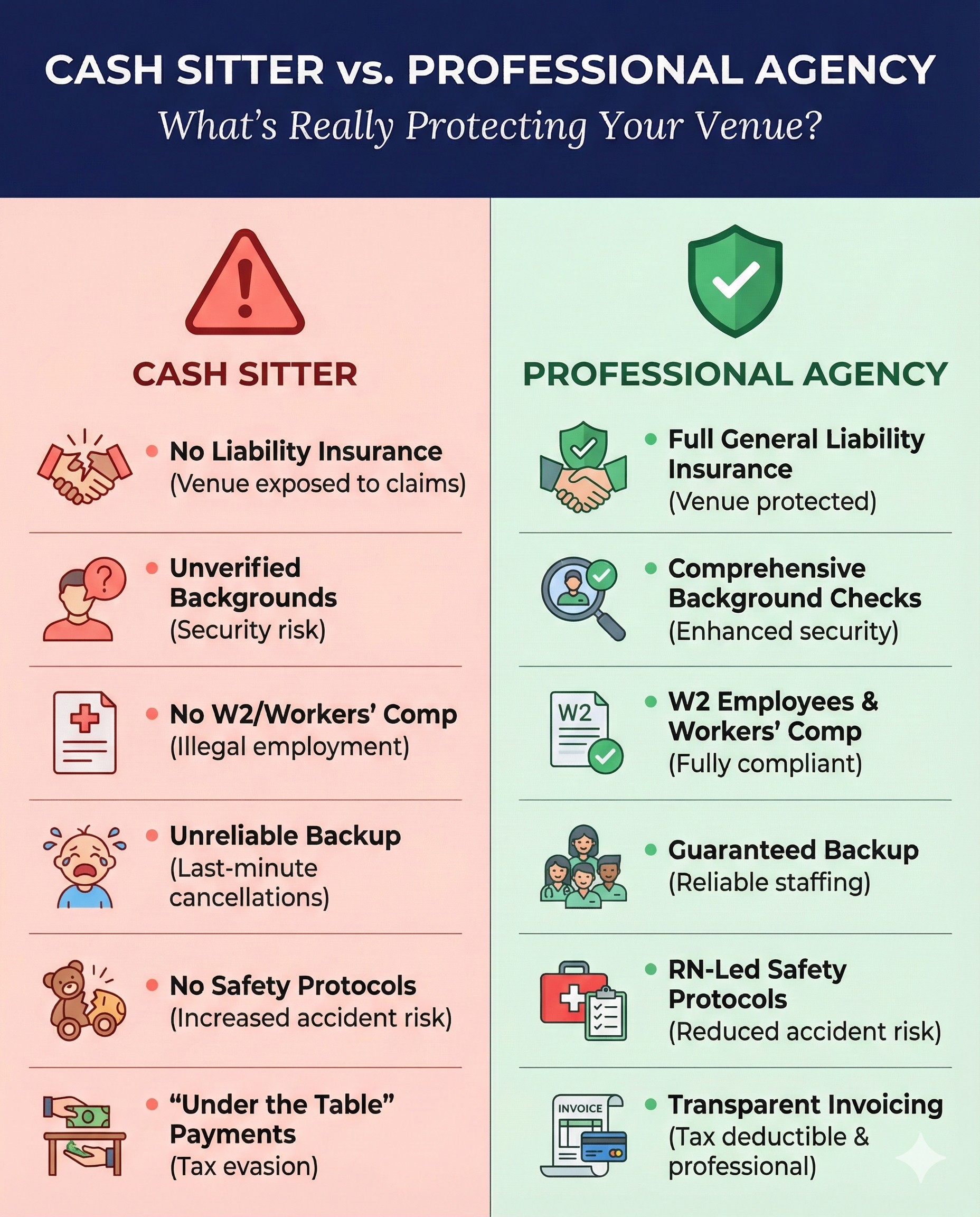
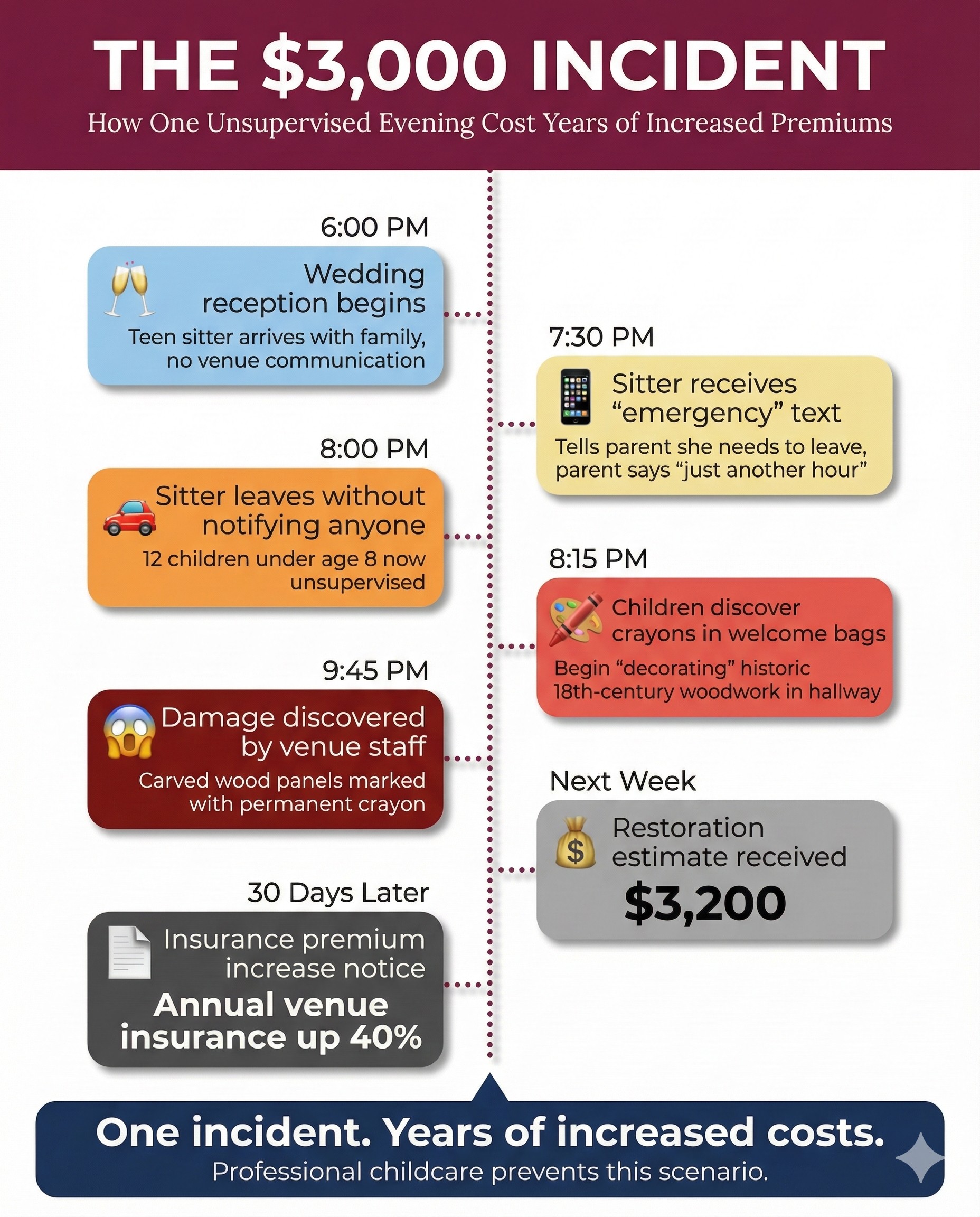
In 2024, a historic Massachusetts estate reported over $3,000 in damage to 18th-century woodwork—traced to unsupervised children during a wedding reception. The family's hired sitter had left the venue early due to an "emergency," leaving 12 children under age 8 essentially unattended for the final two hours of the event.
The venue's insurance covered the repair costs, but the incident triggered a policy review that nearly doubled their premiums the following year.
This is why forward-thinking venues are moving toward dedicated, contained childcare spaces managed by professional agencies.
Rather than children wandering through venues, professional childcare agencies create stationary "Kids' Clubs" in designated rooms. This model provides:
Not all childcare agencies are created equal—and for luxury venues, the distinction matters.
The gold standard in event childcare includes these essential elements:

Agencies led by healthcare professionals (RNs, LPNs, or child development specialists) bring clinical judgment to caregiver assessment. This means evaluating not just references and background checks, but critical thinking skills, emergency response capabilities, and behavioral red flags that standard hiring processes miss.
This clinical background doesn't medicalize the childcare role—caregivers aren't providing medical services. Rather, it ensures the vetting process itself is conducted with the same rigor and judgment healthcare professionals apply to patient safety assessments.
Professional general liability (typically $1-2 million), workers' compensation, and bonding—not just a "business policy" add-on. This insurance is specifically underwritten for childcare operations and covers the unique risks of supervising multiple children in event environments.
Written emergency procedures, allergy management systems, medication administration protocols (when applicable), secure check-in/check-out processes, and incident reporting that protect both families and venues. These aren't just internal documents—they're the systems that demonstrate professional standards if anything goes wrong.
Clear employer-employee relationships that eliminate liability ambiguity and ensure compliance with Massachusetts labor law.
All caregivers should arrive with current CPR/First Aid certification, training in allergic reaction recognition, and protocols for medical emergencies. This isn't about providing medical care—it's about professional preparedness. If a child has a febrile seizure during cocktail hour, the venue isn't scrambling. The childcare team is.
Venues partnering with agencies that meet these standards are effectively outsourcing the risk while elevating their service offering.
In Massachusetts, Nurture Haven Nannies & Co. is the only RN-led childcare agency specifically designed for high-end events, offering this comprehensive model to Boston and Metrowest venues.
Venues are taking different approaches to professionalizing event childcare, each offering varying levels of liability protection:
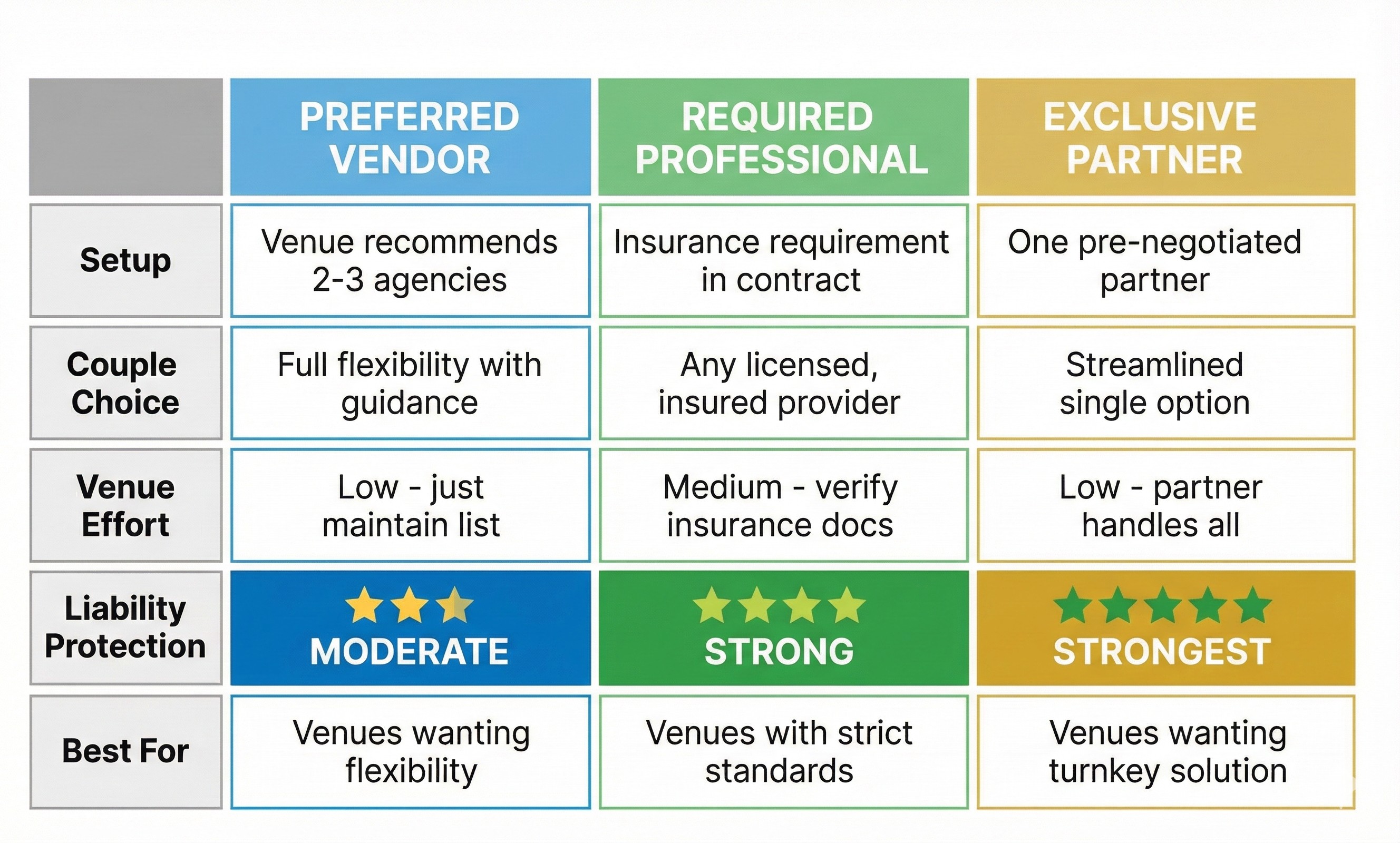
Venues maintain a short list of 2-3 vetted, insured childcare agencies and proactively share this list with couples during the planning process. No mandate, but strong guidance from the wedding coordinator that "these are the providers we trust and recommend."
Advantages: Preserves couple choice while steering them toward professional options. Easy to implement without contract changes.
Liability protection: Moderate. Reduces cash sitter incidents but doesn't eliminate them.
Venues specify in contracts that all childcare providers must carry commercial liability insurance and provide proof of coverage 30 days before the event. Couples can choose their own provider, but it must be a licensed, insured business.
Advantages: Creates a clear professional standard while allowing flexibility. Eliminates the teenager-from-an-app scenario entirely.
Liability protection: Strong. The insurance requirement creates a contractual safeguard.
Venues negotiate a preferred rate with one agency, streamline setup logistics, and include professional childcare as a built-in service upgrade option in wedding packages.
Advantages: Simplest for couples (one vendor, pre-negotiated pricing, venue-coordinated logistics). Creates recurring business relationship with a trusted partner. Often the agency becomes an extension of the venue's service team.
Liability protection: Strongest. Single partner means consistent standards, established emergency protocols, and deep familiarity with venue layout and logistics.
Each model reduces venue liability while improving the guest experience. The key is removing the "guest brings a random teenager" scenario from the equation entirely.
When a VIP client asks, "Who do you recommend for childcare?" your answer positions your brand.
Referring a teenager from a gig app signals a gap in your service model—a detail you haven't fully thought through.
Referring an RN-led, insured agency signals you've considered every aspect of their event—even the ones that don't appear in the contract.
For venues like Lakeview Pavilion in Foxborough, the Charles River Museum of Industry & Innovation in Waltham, or Newton Commonwealth Golf Course, where couples are paying premium prices for full-service excellence, childcare is simply another touchpoint that should reflect that standard.
A five-star hotel or historic estate deserves a childcare partner that matches its sophistication. Professional agencies don't just "watch" children—they create an experience that allows parents to fully participate in celebrations while maintaining the venue's atmosphere and protecting its assets.
As the events industry continues to professionalize post-pandemic, childcare is the next frontier. Venues that proactively address this liability gap—before an incident forces their hand—are positioning themselves as leaders in family-inclusive hospitality.
The shift is already happening. Insurance carriers are increasingly aware of childcare-related claims. Wedding planners are asking about venues' childcare policies. And couples planning family-inclusive celebrations want to know their venue has thought this through.
For Boston and Metrowest venues exploring professional childcare partnerships, the time to build these relationships is now, ahead of the 2026 wedding season. The question isn't whether to professionalize childcare standards—it's which model best serves your venue's needs and protects what you've built.

Marian Saba, RN, BSN, is the founder of Nurture Haven Nannies & Co., Massachusetts' only RN-led childcare agency serving families and events across Boston and Metrowest. With over a decade of clinical nursing experience, Marian established Nurture Haven to bring healthcare-level vetting and professionalism to premium childcare placement and event services.
Venue managers and wedding professionals: Learn more about our Event Care services and how professional childcare creates a better celebration for everyone while protecting your venue.
Planning a family-inclusive wedding? Discover how professional childcare allows parents to fully participate in celebrations while children are safely supervised in a dedicated Kids' Club space.