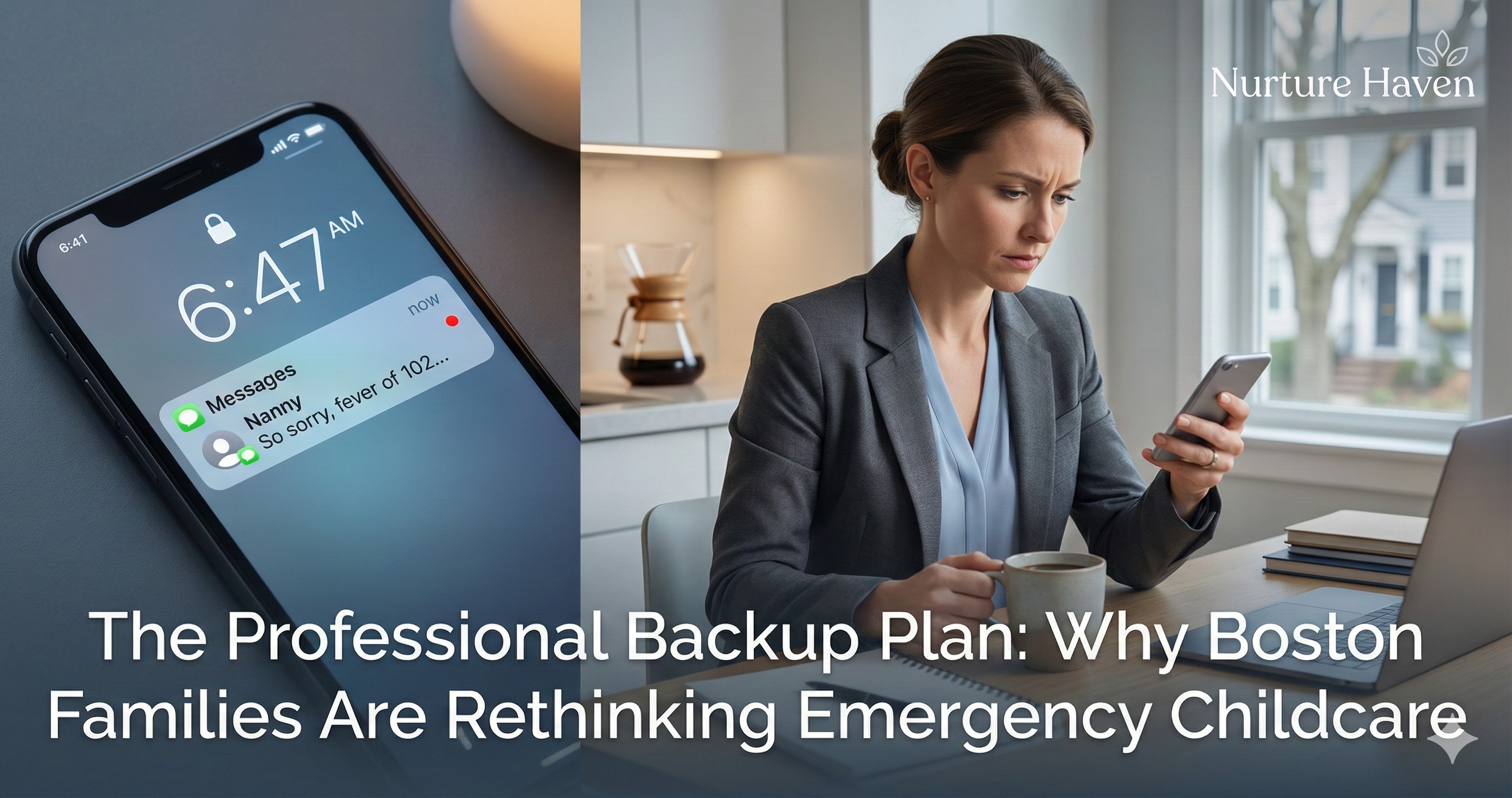
A 6 AM text changes everything. Here's how Metrowest's high-performing families are building resilience into their childcare strategy.
It's 5:47 AM on a Tuesday. Your nanny texts: "So sorry - fever of 102. Can't come today."
Your partner has a 7:30 AM surgery schedule at Mass General. You have a board presentation at 9:00 that's been on the calendar for six weeks. Your kids need to be at Devotion School in Brookline by 8:15.
Welcome to the reality of 2026 childcare in Boston: Even the most reliable arrangements have a single point of failure.
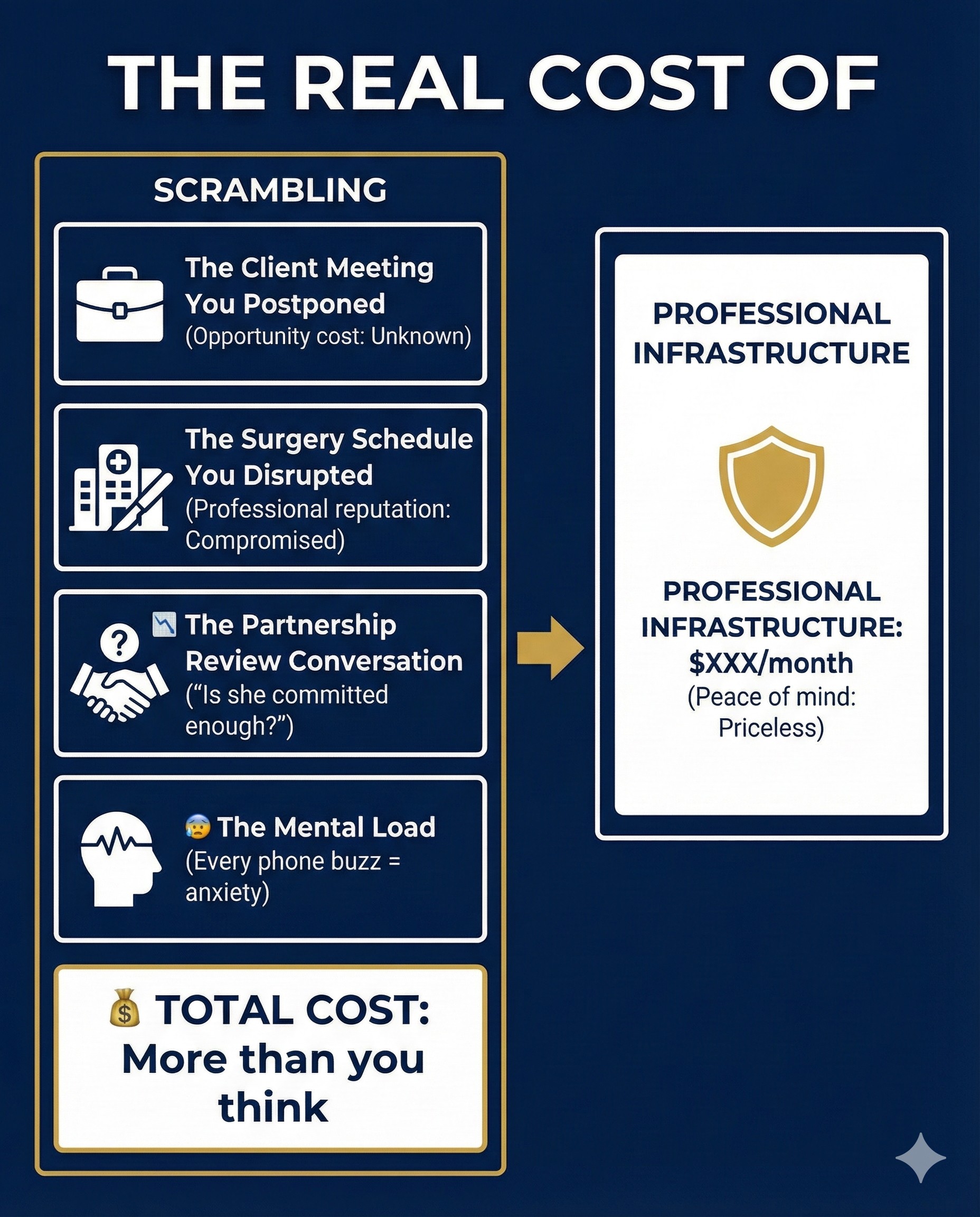
I've watched this scenario play out dozens of times with families across Metrowest and Boston. The parent who cancels the client meeting. The surgeon who has to find coverage. The executive who burns through their own sick days because their childcare collapsed.
The financial cost? Probably hundreds or thousands in lost productivity. The emotional cost? That gnawing anxiety every time your phone buzzes in the morning.
Most parents try to solve this with patchwork solutions:
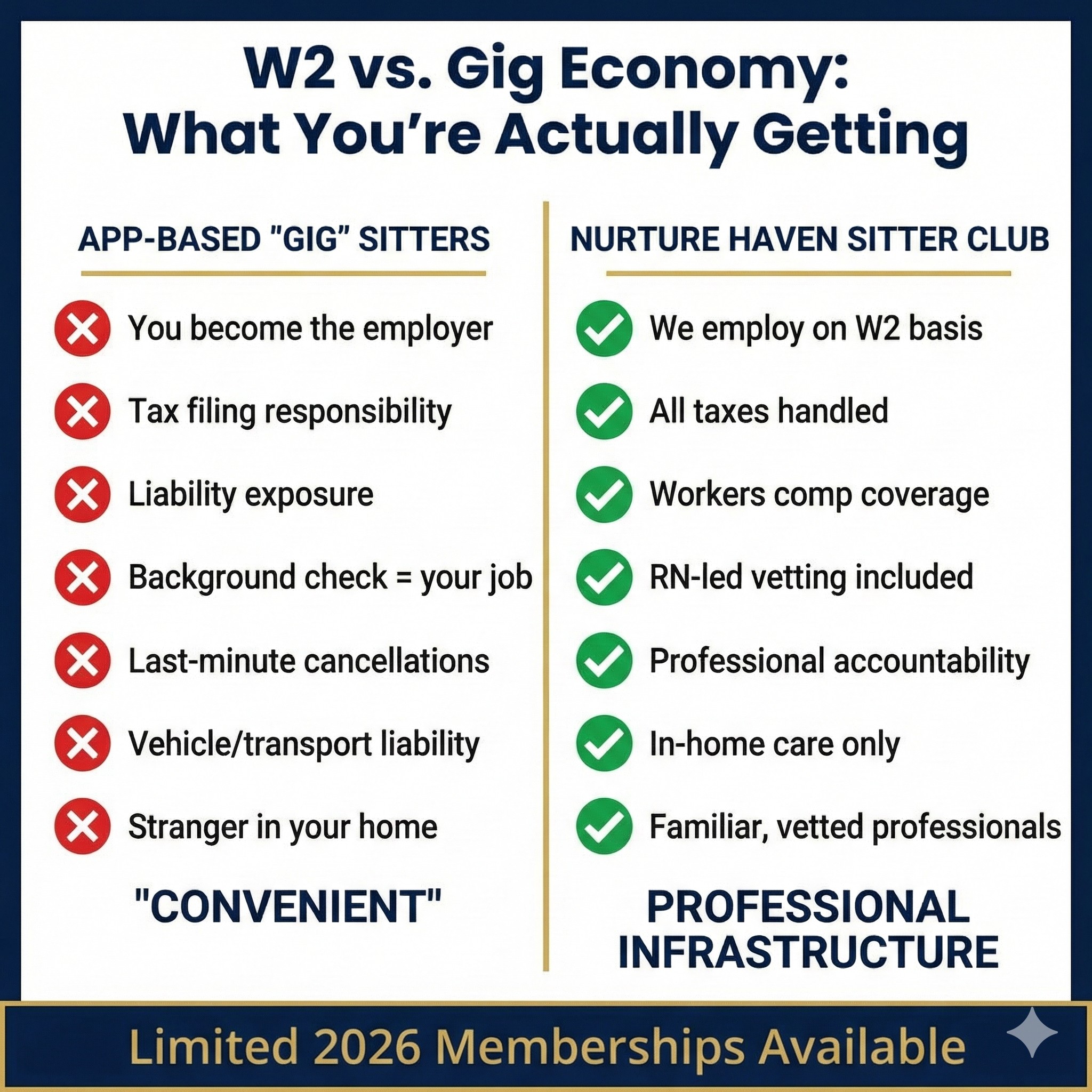
Here's what nobody tells you about that "quick app booking": You're not just hiring a babysitter. You're potentially becoming an employer—with all the tax implications, liability exposure, and administrative complexity that comes with it.
When you hire a babysitter as an independent contractor (which is how most apps and individual sitters operate), you assume significant responsibility:
At 6 AM when your nanny just called out sick and you're trying to salvage your day, the last thing you need is to become an HR department.
And that's before we even address the transportation liability question: If that emergency sitter is driving your kids anywhere, whose vehicle insurance applies? What happens if there's an accident? Did you verify their driving record? Do you have the right car seats properly installed in their vehicle?
The "convenient" solution suddenly becomes very complicated.
After 15 years as an RN and nearly a decade building Nurture Haven, I've noticed a pattern among the families who navigate childcare disruptions most successfully: They don't treat backup care as an emergency—they treat it as infrastructure.
Think about how your company handles critical operations. You don't have one person who knows the password to essential systems. You build in redundancy. You have a bench.
The same principle applies to childcare—especially in a market like Boston where professional stakes are high and backup options are limited.
Here's what this looks like in practice:
Your backup caregivers aren't strangers showing up in a crisis. They're professionals your children have met during date nights, half-day coverage, or weekend mornings. When emergency strikes, your kids see a familiar face in their own home—not someone they've never met trying to navigate your security system, find the sippy cups, or remember which stuffed animal goes with which child at bedtime.
When our Sitter Club members need emergency coverage, they're not introducing their children to a stranger during an already stressful morning. They're calling someone who already knows that Emma needs her stuffed elephant before nap time, that Oliver melts down if his toast isn't cut into triangles, and exactly where you keep the extra diapers.
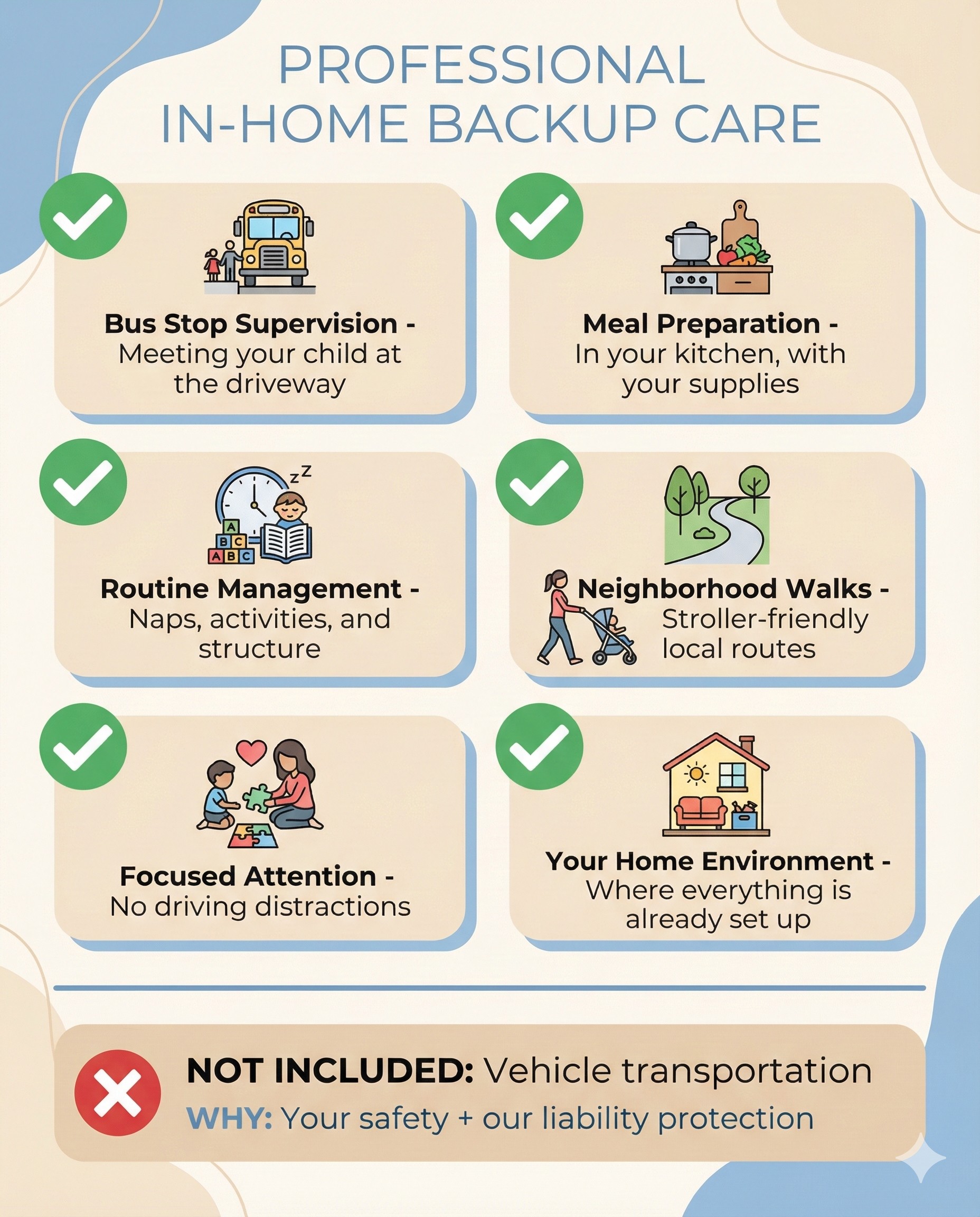
Our caregivers provide attentive, focused in-home care—meeting the bus at your driveway, supervising backyard play, managing indoor activities, preparing meals in your kitchen, and maintaining the routines your children already know. They're not splitting attention between childcare and driving logistics.
As an RN, I apply the same assessment standards to every caregiver in our network that I used evaluating surgical staff. This means:
Your "backup" has passed the same vetting as your primary nanny. When you're booking emergency coverage while you're getting the kids dressed and packing lunches, you're not wondering if this person is safe—you already know they are.
Here's where Nurture Haven's Sitter Club operates fundamentally differently from apps, individual sitters, or informal arrangements:
We employ our caregivers on a W2 basis.
What does this mean for you? Everything.
When you book backup care through our Sitter Club, you're not hiring an employee—you're booking a professional service. We handle:
You get professional childcare without becoming an employer. You book coverage, we handle everything else.
This is particularly important for high-net-worth families, dual-professional households, and anyone who understands that liability protection isn't optional—it's essential.
Our Sitter Club model is built around a simple principle: Professional caregivers provide their best care when their full attention is on your children, not on traffic, parking, or vehicle logistics.
We don't provide transportation services. Our caregivers offer:
For families using Sitter Club as backup care, this makes perfect sense: Your primary nanny handles the daily transportation logistics—school dropoff, activity carpools, errands with kids in tow.
Our role is different: We provide the emergency safety net when your nanny can't be there, keeping your children safe and cared for in your home while you handle your professional obligations.
This approach also protects your family from vehicle-related liability. When caregivers aren't transporting children:
For the working parent who gets the 6 AM text that their nanny is out sick, the priority isn't "who can drive my kids around today?" It's "who can keep my kids safe at home so I can get to my board meeting?"
That's exactly what we do—and we do it with complete focus and professional attention.
Our caregivers know Metrowest and Boston neighborhoods inside and out. They understand the rhythm of your community—when the elementary school bus arrives on your street in Wellesley, which walking routes to the playground in Needham are safest with a stroller, how to handle the doorbell chaos when the Amazon delivery arrives during naptime in your Newton home.
They know which local parks in Framingham have the toddler-friendly equipment. They can navigate a neighborhood walk in Wayland even in February. They understand the Brookline school bus schedule and can be waiting at the corner at exactly 3:07 PM.
This isn't someone Googling your address while your kids cry in the background. It's a professional who knows the territory and can handle the Tuesday morning chaos with competence—all while keeping your children safe and engaged in your own home.
There's a fundamental difference between gig-economy babysitting and professional childcare infrastructure.
When a caregiver is part of our W2 employment network—with benefits, professional development, and ongoing relationship with our agency—cancellations have real consequences. Reliability isn't optional. It's how they maintain their standing in our network, their hours, and their professional reputation.
We're not a marketplace connecting you to independent contractors who can cancel consequence-free. We're an employer maintaining professional standards for our staff.
When you book through Sitter Club, you're accessing a system designed around accountability, not convenience.
I've been transparent about Nurture Haven's evolution: We've deliberately moved away from high-volume, low-price babysitting toward a boutique model serving families who value professional infrastructure over cheap hourly rates.
Our Sitter Club membership is intentionally limited.
Why? Because we can only maintain the "professional bench" model if we're not overpromised and understaffed. We prioritize families who have the highest stakes—the ones where a childcare failure means a cancelled surgery, a missed board meeting, a lost client relationship, or a partnership review that questions your commitment.
This isn't artificial scarcity. It's resource management. When you need us at 6 AM on a Tuesday, we need to actually be able to help you—not tell you we're fully booked because we accepted too many members.
We serve our Elite Placement families first (backup care is part of their partnership with us), then a carefully limited number of Sitter Club memberships for families who understand the value of professional infrastructure.
We're deep into flu season right now, entering the peak months for nanny sick days, RSV outbreaks, and unexpected school closures. This is when backup care goes from theoretical to critical.
The families who've already built their professional backup system? They're managing. The ones still operating on hope and scramble mode? They're struggling.
I'm getting calls every week from families who "never thought they'd need backup care" because their nanny has been reliable for three years—until she wasn't. Until the flu hit her household. Until her own child got sent home from daycare. Until a family emergency required her to take a week off with 24 hours notice.
Reliability isn't about character. It's about reality. Life happens. Systems fail. The question is whether you have professional infrastructure in place before you desperately need it.
One of our placement families—both physicians with demanding schedules at Boston hospitals—learned this lesson early. They built backup care into their monthly rhythm from day one: a Saturday morning here, a Friday afternoon there, rotating through our Sitter Club caregivers.
Not because they didn't trust their nanny. Because they understood infrastructure.
When their nanny had a family emergency last month requiring a week off, their kids already knew the backup caregiver who stepped in. No tears, no chaos, no panicked schedule reshuffling. The caregiver already knew their home, their routines, their children's quirks and preferences. She kept the household running smoothly while the parents managed their hospital schedules without disruption.
One parent told me: "I didn't realize how much mental space that anxiety was taking up until it was gone. I don't worry about the 6 AM text anymore because I know we have a system."
That's not luck. That's strategy.
Whether or not you work with Nurture Haven, here's what I recommend for every high-performing family in Boston and Metrowest:
Be brutally honest. Can Grandma in Worcester really get to Brookline by 8 AM on a Tuesday? Is your neighbor actually available during work hours, or are you counting on someone who has their own job and obligations?
Write down your actual, realistic backup options. If the list is shorter than you thought, that's important information.
If you're hiring individual sitters or using app-based services, talk to your insurance agent about:
The cheapest option often becomes the most expensive when something goes wrong.
Have your backup caregivers meet your kids during non-crisis times. A Saturday morning trial run is worth its weight in gold when Thursday morning goes sideways.
Your kids need to know who's coming. You need to know how they interact with your children. And the caregiver needs to know your home, your routine, your systems before they're walking into chaos.
The fastest available sitter on an app might be available, but do you know anything about their judgment, their training, their actual experience, or their reliability history?
Professional vetting costs more upfront. Scrambling costs more in the long run.
What does your last-minute cancellation actually cost?
Now compare that to the cost of professional backup infrastructure. The math usually becomes very clear.
One backup isn't enough. You need a bench, not a single alternative.
What happens if your primary backup is also sick? What if they're already committed to another family that day? What if they moved out of state?
Professional infrastructure means multiple options, not a single point of failure replacement.
Be clear about what you actually need when your nanny calls out:
Do you need someone who can handle the full daily logistics—school transportation, activity carpools, errands across town? That's a different service model (and typically requires your primary nanny or a temporary full-scope placement).
Or do you need someone who can keep your kids safe, fed, and engaged at home while you handle your work commitments—with one parent managing school pickup/dropoff if needed? That's professional backup care.
Understanding this distinction helps you build the right infrastructure for your actual needs, not some theoretical "do everything" fantasy that doesn't exist at 6 AM on a Tuesday.

If your 2026 childcare plan relies on "hoping nothing goes wrong," it's time to rethink your infrastructure.
Ask yourself:
For families in our network—whether full placement clients or Sitter Club members—this is exactly why we've built what we've built. Not as a luxury, but as essential professional infrastructure for families with high-stakes careers and complex schedules.
The difference between families who navigate childcare disruptions successfully and those who constantly struggle isn't luck.
It's not even about having more money or better nannies.
It's about understanding that professional backup care is infrastructure, not indulgence.
It's about building systems before you desperately need them.
It's about choosing professional accountability over gig-economy convenience.
It's about protecting yourself from the legal, financial, and professional risks that come with emergency scrambling.
And it's about being honest with yourself about what kind of backup care actually matches your family's needs—and building a system around that reality.
Nurture Haven's Sitter Club enrollment for 2026 is intentionally limited to ensure we can serve our families when they need us most. We prioritize our Elite Placement families and a select number of memberships for Boston and Metrowest families who value quality, reliability, and professional infrastructure.
If you're tired of the 6 AM panic and ready to move from scramble mode to infrastructure mode, let's talk about whether our model makes sense for your family's needs.
Contact Nurture Haven Nannies & Co. to learn more about Sitter Club membership and how RN-led vetting creates the professional backup system your family deserves.
Serving Boston, Brookline, Newton, Needham, Wellesley, Weston, Wayland, Framingham, and Metrowest Massachusetts families who refuse to compromise on childcare quality.